
The chambers with invisible doors in them is the most current home decorating trend. They craft a neat, cohesive appearance by merging a door completely and the wall so that the door becomes almost impossible to discover. Many home owners and interior decorators apply the secret doors to create the innermost rooms, the home offices, the secret storages, or the minimalist parts of the house.
Knowing how to make an invisible door is definitely a step in the right direction if you are considering a home transformation with a fashionable and one-of-a-kind wall feature. Hidden doors notwithstanding their intimidating appearance, it is actually not so hard to create one with suitable materials, planning, and installation techniques.
In this article, we will cover what you must know to make an invisible door: the list of the necessary materials, the ideas for the design, and the stepwise guide for the making of the door. To maintain a seamless modern interior, pairing invisible doors with elements like an Aluminium section window can further enhance the clean and minimal aesthetic of your home.
What Is an Invisible Door?
It is a door completely camouflaged with the wall around it that it becomes almost impossible to detect.
In contrast to the conventional doors with conspicuous frames, handles, and decorative panels, the invisible doors make use of hidden frames and the least possible hardware. Usually, the door is covered with the same surface treatment as the wall, for example, paint, wallpaper, wooden panels, or the wall panels. This makes the door 'disappearing' visually and makes one harmonious wall design.
Invisible doors are a common feature in contemporary dwellings, luxury suites, offices, and interiors of a creative nature.
Benefits of an Invisible Door
One of the reasons that invisible doors are gaining more and more popularity among interior designers is that
1. Modern and Minimalist Design
Invisible doors mainly result in a clean and in an elegant look. Due to their nature minimalism can be completely focused upon as there is very little distraction.
2. Hidden Spaces
Invisible doors are a great use of space as they can be the entrance to areas such as storage rooms, home offices or even personal spaces.
3. Better Aesthetic Appeal
As the door merges with the wall it results in an enhanced overall visual appeal of the room. Similarly, incorporating an Aluminium window in your space complements the hidden door concept by offering a sleek, durable, and visually consistent design.
4. Space Optimization
Invisible doors could visually elongate a room since there would be no visible door frame or door structures.
Types of Invisible Doors
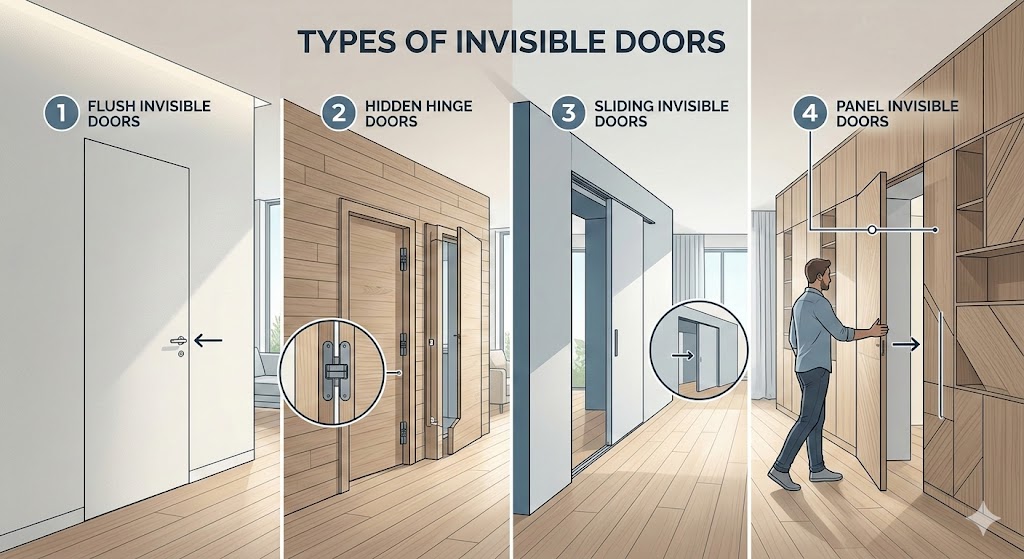
First of all, you need to know about the different types of invisible doors that exist before you decide on the one you want to make.
1. Flush Invisible Doors
They are flush doors and the wall surface and the door panel appear to be a single continuous surface.
2. Hidden Hinge Doors
Hinges are hidden in this type of door so even when the door is open no hinges can be seen.
3. Sliding Invisible Doors
Sliding doors may also be HIDDEN IN the wall, providing a hiding entrance.
4. Panel Invisible Doors
Such doors are disguised as decorative wall panels or shelves and thus they perfectly fit with the appearance of the wall.
Materials Required to Make an Invisible Door
These are the materials that you may want to consider using to make an invisible door along with the mentioned tools.
The door panel could be made of the following:
- wood
- MDF
- plywood
The other necessary materials are:
- hidden door frame
- concealed hinges
- door closer or magnetic lock
- screws and anchors
- measuring tape
- drill machine
- spirit level
- wall finishing material (paint, wallpaper, or paneling)
Using good quality materials is very important if you want your door to function well and be long-lasting.
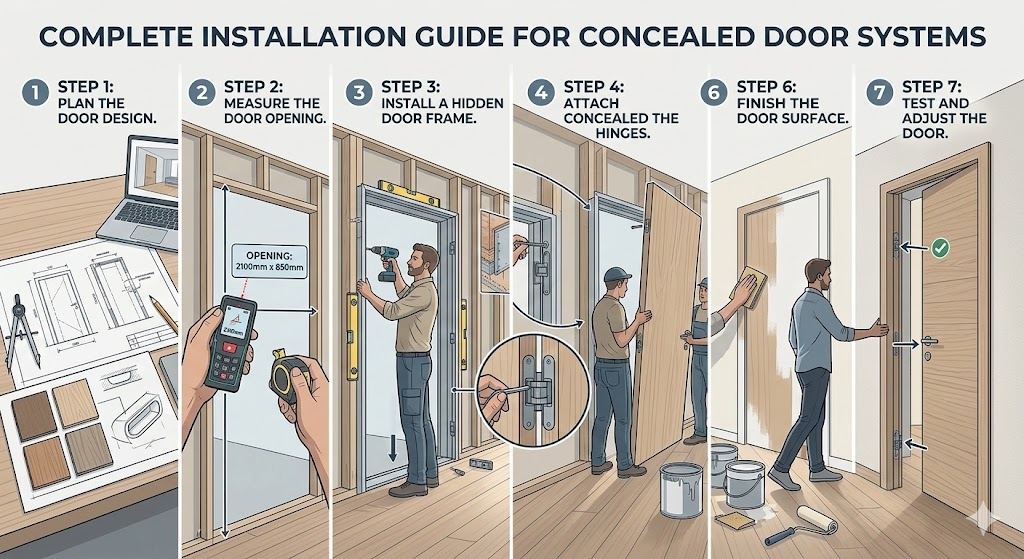
Step 1: Plan the Door Design
How to make an invisible door first step is to plan the design.
You have to decide on the place of the door as well as the method of blending it with the wall. Hallways, living rooms, or bedrooms are the common locations for installing the invisible doors.
The color and texture of the door should be in harmony with the wall so that the door is barely visible. To make the door completely hidden, some homeowners go to the extent of installing wall panels or even shelves.
Planning properly will help you to make the door an ideal element in your interior design.
Step 2: Measure the Door Opening
When it comes to making an invisible door, the precision in the measurements cannot be overstated.
Measure the height and width of the wall opening where the door will be installed. Make sure you get the right size for the door panel so that it fits in the space without any problems.
Invisible doors are characterized by very narrow gaps between the wall and the frame to maintain the seamless look.
By taking the exact measurements, the final result can look really professional.
Step 3: Install a Hidden Door Frame
A suitable hidden door frame is the very base of invisibility.
Hidden frames, as opposed to normal door frames, are fixed within the wall to the extent that they are not visible from the outside at all. The frames are generally made out of aluminium or other strong metals.
Using screws and anchors, mount the hidden frame inside the wall opening. Use a spirit level to make sure the frame is perfectly aligned.
The text of the paragraph explains how to install a proper hidden door frame.
Step 4: Attach Concealed Hinges
Concealed hinges play a significant role in an invisible door.
The installation of these hinges is not visible once the door is closed as they are hidden in the frame and the door panel. They make possible the smooth opening of the door without spoiling the overall look.
First, fix the hinges on the door panel and after that to the hidden frame using screws.
Check the correct alignment of the hinges to avoid problems when opening or closing the door.
Step 5: Install the Door Panel
Next, after the frame and hinges are mounted, set the door panel.
Lift the door panel and secure it to the concealed hinges. After installation, test the door movement to ensure it opens and closes smoothly.
Instead of installing traditional handles, push-to-open systems or magnetic locks are generally used for invisible doors. This promotes the seamless wall look.
Perform alignment adjustments as necessary.
Step 6: Finish the Door Surface
Finishing the door surface is basically the most critical task in making an invisible door.
The point here is to make the door indistinguishable from the surrounding wall. Same paint, wallpaper, wooden paneling, and even texture of the wall can be used.
You can:
- Repaint the door in the wall color.
- Use wallpaper that is continuous over both the wall and door.
- Mount decorative wall panels.
- Make bookshelf-type hidden doors.
When done right, the door becomes almost invisible.
Step 7: Test and Adjust the Door
This is your time to make sure that nothing defies the door's smooth operation and your expectations are met. Also, a few final tweaks here and there might just make all the difference.
Open and close the door to ensure that the operation is smooth. Check for any problems with the alignment and any gaps and fix them.
Invisible doors when closed should remain flush with the wall and operate quietly.
The adjustment of the door is a big factor in long-term functionality.
Design Ideas for Invisible Doors
If you want to create a unique hidden door, there are many creative design options.
Hidden Bookshelf Door
A bookshelf can be a door that opens to a secret room.
Panel Wall Door
The door can be a part of the decorative wall panels.
Mirror Door
A door hidden behind a full-length mirror can completely surprise a person.
Wallpaper Door
Wallpaper that flows across the door hides the edges of the door quite well.
These creative ideas make invisible doors both functional and stylish.
Common Mistakes to Avoid
When learning how to make an invisible door, it is important to avoid some common mistakes.
One is to use hinges that are visible, or to use the door frames which are bulky. These will take away the feeling of the door being hidden.
On the other hand, one more mistake is the door frame alignment that is not done properly. Even the small spaces are enough to reveal the door.
The use of different paint or wall finishing materials to make the door is another big no.
Planning in detail is a must if you want a perfect invisible door.
Maintenance Tips for Invisible Doors
If the installation is perfect, then invisible doors need hardly any maintenance.
It is a good idea to regularly check the hinges mainly to be sure that they have remained tight and functional. If you want the door surface to appear the same as the wall then cleaning it regularly is a must.
For the doors that utilize a push-to-open system, checking the smoothness of the mechanism is a must.
If adequately looked after, hidden doors can be just as functional as your ordinary doors and still maintain their seamless looks.
The knowledge of how to build an invisible door may be the very thing that is going to assist you in making a really chic and very modern wall decor element. They are excellent for furnishing your home as such features give you a clean and minimalist look and on top of which, can be used to conceal your private spaces.
Using a concealed frame in combination with hinges that are not seen and decorating the wall with the finishes that match the door allows you to make a door that is totally blended in with the wall. Proper planning, accurate measurements, and careful installation are key to achieving the best results.
You may be thinking about hidden room, secret storage or simply a unique design element and invisible doors are great solutions for contemporary homes.
Related Post:
How to Install Aluminium Door Frame
Aluminium Door vs Wooden Door
UPVC Windows vs Aluminum Windows